Leadership Isn't a Title. It's a Decision
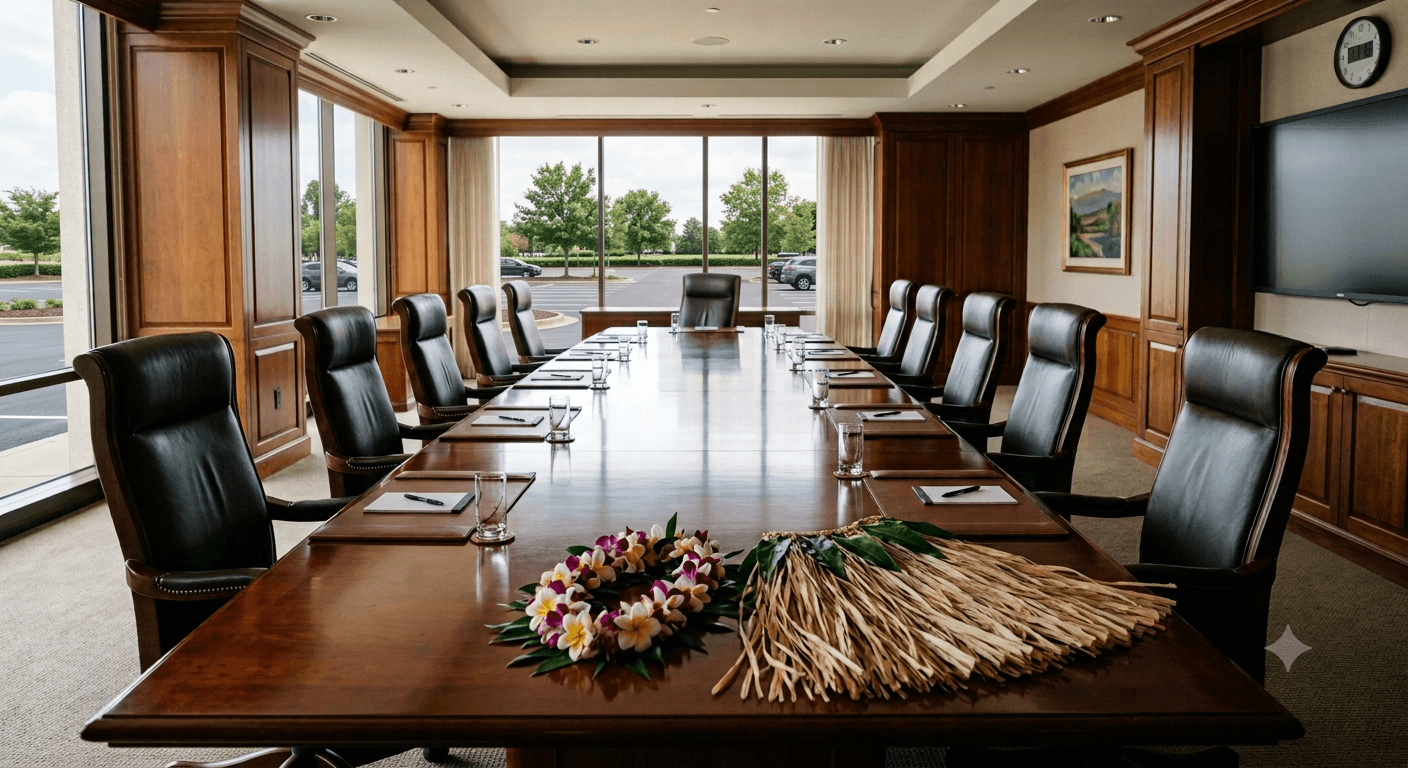

A boardroom dressed for a skit - where an intern first learned a title was never the thing that made a leader.
Have you ever worked with someone who went out of their way to make sure you were supported? Not a manager, but a coworker who made it their top priority when you asked for help. They didn't just solve the problem, they showed you their thinking and taught you something new? That's a leader.
I don't think leaders are made by an org chart. I think they're made by a mindset, showing up to own a problem whether or not it's yours to own. Here are four moments, at every stage of my career, that drove it home.
The intern that set the stage
When I was an intern at my first software job, myself and all the newcomers had to put on a skit as an initiation activity. The skit was meant to be something funny to break the ice with the rest of the company. A few weeks before we were meant to show it off, the 10 of us met in the evening at the end of the workday.
The meeting was chaos. Everyone was shouting out different ideas and no one was building them into anything we could actually use. I'm not sure if it was because I was at the head of the table or that I was hungry and knew we had to solve this before I could have dinner, but I spoke up. I switched modes into capturing ideas and asking probing questions to build them. When someone raised an idea that didn't make sense, I didn't shut it down. I asked how we could include others, and they'd realize the idea was limited on their own. It only took 10 minutes to land on a game show skit, with me as the MC.
Me, an intern, brought a room of senior salespeople, technicians, and senior leaders to a conclusion. No one asked me to. I didn't even go in thinking that would be the outcome. I saw an opportunity and I took it. I saved us hours of circular debate by driving to a clear outcome, one everyone had a hand in deciding, so everyone bought in. The skit wasn't half bad in the end.
The junior that built the foundation
Later in my career, I was working with an engineer as her manager. We were building a new platform to power a refreshed UI for the company's product. She was working on a networking layer that would serve as the foundation for all frontend API requests. She submitted a pull request for the first version, and the director of the project did a review. He left almost 100 comments, nearly one on every line.
Most engineers in her position would have been discouraged and gone looking for a new project. For her, it was the push she needed. She took the feedback and rewrote the entire networking backbone for the application. She went further and rewrote our REST protocols too, once she realized the director's feedback pointed at problems bigger than her original PR. She owned the solution.
Her work laid the groundwork for hundreds of engineers who followed onto the new platform. It's still in use today, and unsurprisingly, she's now a senior engineer. Thanks to her, the API layer is more consistent and extensible than anything we had before.
The manager that rallied his peers
Around the time of the networking layer change, a peer manager of mine wanted to pull together the other engineering managers to talk through ways we could improve our practices. He set up a meeting and invited me and a few others. It worked. Each manager showed up with a different problem and a different way of solving it, and we all left with something we didn't have before.
I saw an opportunity to take his idea and grow it. I asked if he'd be willing to host it if there were more people in the room. He said he'd love that, so I got to work, pulling in managers from everywhere I could reach in the organization. Our meeting of 5 turned into 30 within a week. Once I'd helped it grow, I got out of his way. It wasn't mine to run, and I knew that.
That meeting is still running today. Teams that would have never crossed paths now learn from each other's mistakes before making them, and managers across the org lean on each other to fix what isn't working on their own teams. One person's idea turned into a permanent piece of how we lead.
The senior that found the money
One last leader I worked with earlier in my career showed me how to perform under pressure without putting blame on anyone at fault. While managing a team building a database ingestion platform, we got a bug report of a terrifying issue of lost trade transactions accounting for millions of dollars. A senior engineer on the team and I jumped on a call with the customer right away. With systems like this, it isn't uncommon to need a replay of data to recapture the correct series of events. In this case, the customer had lost thousands of transactions totalling millions of dollars, but when we went to replay them, it kept failing. The transactions weren't being recorded.
We traced the code line by line, searching for the issue. Late that night, we found it: a recent change to the replay logic, made by the team's principal engineer, had switched an index check from < to >=. It seemed like a small change, but it had completely changed the behaviour. With the issue diagnosed, the senior engineer deployed a patch and we were able to replay the transactions. Millions of dollars, not lost.
The next day, we pulled the team together to discuss the incident. I hadn't had time to prep the senior engineer on how to present the findings. It turned out I didn't need to. He pointed out the issue and made the whole thing blameless. It was a shortcoming of our tests and failure recovery, he said. At no point did he name who'd made the change, or ask why. We made concrete plans to add guardrails so it wouldn't happen again. The grace in his leadership that moment stuck with me. He could have been resentful about staying up half the night over someone else's mistake. Instead, he used it to educate the team and prevent the next one.
Be a leader
Titles didn't make leaders of any of these four examples. Owning the problem did.
There's probably a stalled meeting, a tough piece of feedback, a good idea that needs a push, or a mistake about to get buried near you right now, waiting for someone to step up. That's your opportunity.
The thoughts and views expressed here are my own.
Subscribe for updates
New posts in your inbox now and then.
If you are looking for comments, you won't find them here, but I'd still love to hear your opinion. Send me an email or message me on social media.